
Chase County Mugshot Sources
Chase County does not publish a released-person mugshot gallery. Its BlueHorse jail interface is built around people currently listed in custody. A profile may carry a booking image while the record is active, but the Chase configuration disables public past-inmate access. Once a person leaves the display, the photo may no longer be reachable there. That change is not evidence that the record was erased, sealed, or expunged. It also does not show whether the person entered the community or transferred to another custodian.
| Channel | Photo? | How to access |
|---|---|---|
| Chase sheriff roster | Possible current profile image | Check the live roster while the person is listed |
| CCDC KORA request | Requestable, disclosure not guaranteed | Ask for the named booking photo and release sheet |
| KDOC KASPER | Correctional photo may display | Choose Show Photos and match the KDOC record |
| KBI registry | Current statutory photo for qualifying registrants | Search only when registration law applies |
| Official agency news | Sometimes | Check the sheriff, KBI, KDOC, or prosecutor source |
| Commercial mirrors | Older image may persist | Treat only as an unverified lead, not release proof |
The county booking photo, a KDOC correctional image, and a KBI registration photo are not interchangeable. They may have been taken at different times for different legal records. Compare full name, date of birth, agency number, case number, and other identifiers before concluding that two images concern one person.
Chase County Roster Photo Limits
The official Chase County jail page leads to a current roster. Its “Books 24hr” label means bookings within a prior-day window, not people released during that period. The public controls do not supply a release-photo tab, a three-day release archive, or a documented period for keeping a departed profile online. Calling that booking view a release gallery would reverse its meaning.
When a current profile includes an image, use it only to help distinguish the person shown in that custody record. The picture does not establish the release time or reason. A missing profile may reflect release, transfer, data lag, a spelling mismatch, or suppression. Call Chase County Detention Center at 620-273-7054 and request the booking/release record when the custody event matters.
A current roster photo supports identity checking, but only the release sheet and controlling order document why and when Chase County custody ended.
Request Chase County Booking Photos
A narrow Kansas Open Records Act request is the best official fallback after the live profile disappears. Address detention records to Chase County Detention Center or the Sheriff's Office. Do not assume the County Clerk personally holds jail photographs. Identify the exact existing records sought and give enough detail to separate the booking from people with similar names.
- Use the Chase County KORA form.
- Provide the full name, aliases, date of birth, approximate arrest and release window, booking number, and case number when known.
- Ask for the booking photograph tied to that booking and the booking/release sheet showing admission, release time, release type, authority, and transfer disposition if recorded.
- Request electronic copies, segregation of open material, and a cost estimate before chargeable work.
- If any part is denied, request the written statutory basis rather than assuming the whole booking record is closed.
Kansas law requires the agency to act on the request by the end of the third business day. The agency must provide the record, state when and how it will be supplied and at what cost, or explain why it cannot be provided. This is a response deadline, not guaranteed final production. Chase County publishes no fixed jail-photo fee, so ask for an estimate. Complex retrieval or legal review may take longer.
Send the request to Chase County Detention Center/Sheriff at 301 S. Walnut, Cottonwood Falls, KS 66845. The facility number is 620-273-7054. Sheriff Jacob Welsh's office number is 620-273-6313. A written photo request creates a clearer record than a general question about whether a picture exists.
Kansas Law on Chase Mugshots
Kansas KORA favors access to public records unless another law closes them. K.S.A. 45-221(a)(29) identifies specified correctional photographs and identifying information as public within KDOC records. That supports access to qualifying state correctional photos. It does not create a blanket promise that every local arrest photograph must be disclosed in every context.
K.S.A. 45-221(a)(10) permits withholding some criminal-investigation records unless statutory or court standards for disclosure are met. A Chase County booking photo can be treated according to its record context and agency practice. Ask for the image attached to a named booking sheet, request open portions, and seek written grounds for any denial. Juvenile, victim-identifying, sealed, expunged, treatment, and certain investigative data may be restricted.
The official statute page shows the public correctional-photo category and the limits that require a record-specific request.
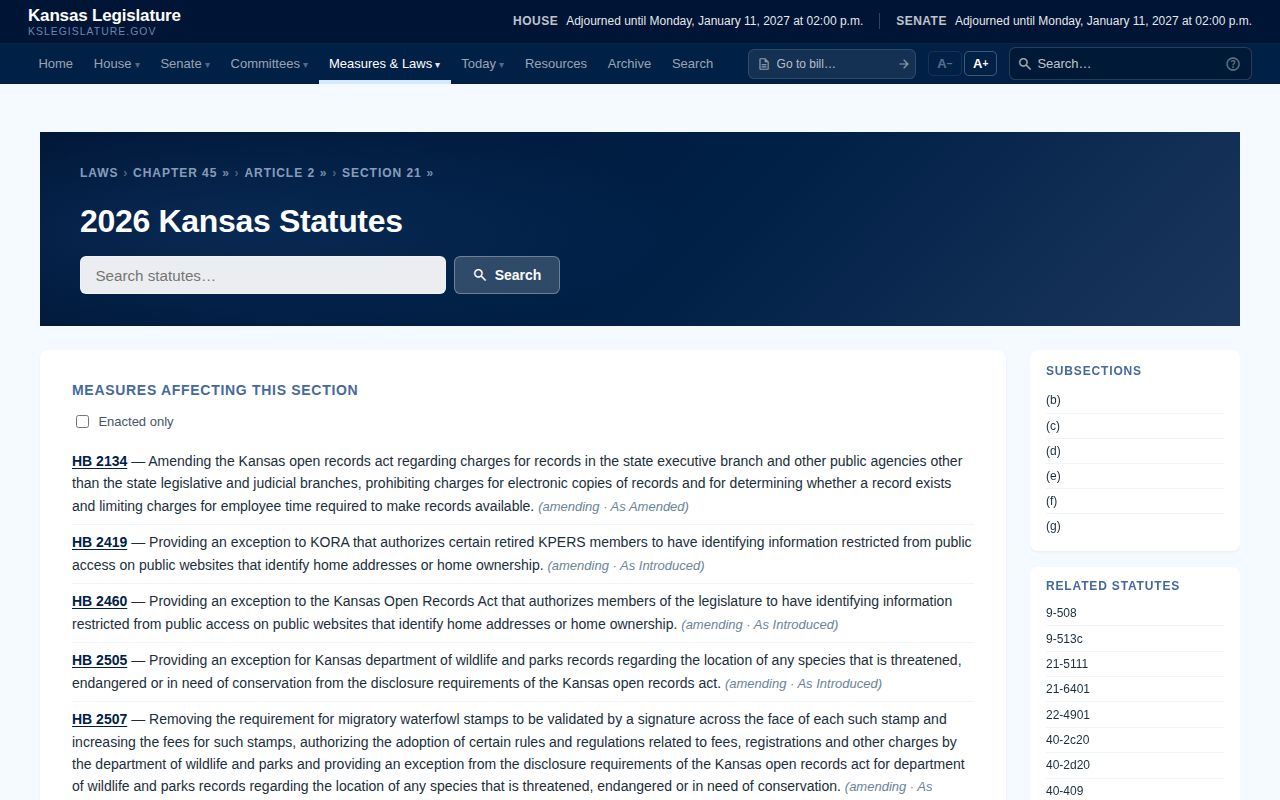
The image connects the photo channel to Kansas law without suggesting that all booking images are automatically open.
Chase County KDOC Photographs
KASPER can display a state correctional photo for a person sentenced to the Secretary of Corrections. Open the KASPER search, choose Show Photos or Display Thumbnail Photos, and search by KDOC number when possible. A name search should be narrowed with birth date, conviction county, or physical identifiers. Open the full record and read the status and movements with the image.
A KASPER photograph is not necessarily the photo taken at Chase County Detention Center. It belongs to the KDOC record. KASPER covers state-sentenced people who are incarcerated, supervised after prison, or discharged. Someone booked and released locally without a KDOC commitment may never appear. “Conviction County: Chase” identifies the court of conviction, not the current home, facility, or destination.
Status carries more release value than the photo. Parole or postrelease supervision indicates the prison portion ended while state supervision continues. Discharged means the KDOC obligation ended. A future anticipated date is not release proof. KASPER refreshes on working days, so the supervising office or KDOC should resolve a same-day conflict.
Chase County Registry Photos
The Kansas Bureau of Investigation registry publishes a current photograph for people who must register for qualifying sex, violent, or drug offenses. It is not a list of all released Chase County inmates. A registry match may support that a qualifying person has a community registration record, but it cannot establish when or why the Chase jail released that person.
KBI says its online data updates every fifteen minutes and partly depends on information supplied by registrants. The agency does not guarantee completeness. Names and birth dates are not conclusive identification; KBI says fingerprints are required for a positive match. Some older and protected records do not appear. Use the official KBI registry only within that limited scope.
A registry photo can be newer than a jail or prison image. That is precisely why it must stay attached to its own record type. An error in a registry photograph or status belongs with the KBI Registered Offender Unit. Correcting the registry does not automatically change the sheriff's booking record or KASPER.
No Chase Mugshot Release App
No official Chase County sheriff-branded inmate-search or recent-release mobile app was found in the reviewed official navigation and app sources. Communications, calling, visitation, commissary, and payment services linked by a jail serve different tasks. They are not public release-photo tools. VINEMobile is part of the statewide VINE notification system, not a sheriff gallery.
VINE can send a county-jail custody-change alert when registration occurs before the event. It does not preserve the complete booking photo or state the full legal reason for release. Kansas VINE also excludes KDOC prison residents. For a photograph after a Chase jail departure, the narrow KORA request remains the sound route.
Official sheriff, KBI, KDOC, or prosecutor news may carry a photograph connected to a specific event. No official policy of routinely posting released-person photos was located for Chase County. A news image proves publication in that story, not present custody or later release status.
Property After Chase County Release
Chase County Detention Center says original approved personal mail is placed with a person's property for access after release. A transfer changes that simple picture. Items can become subject to the receiving facility's rules, return charges, or disposal. Leaving CCDC does not always mean ordinary property pickup or community release, especially in a building that holds local, ICE, and USMS detainees.
Call before making assumptions about how property or mail can be retrieved. If an image or other published jail data appears inaccurate, CCDC directs written accuracy complaints to 301 S. Walnut. Keep that correction request separate from a KORA request for the actual photo and release sheet, since one challenges data while the other asks for records.
Expunged Chase County Mugshots
K.S.A. 21-6614 governs Kansas conviction expungement. Eligible requests are filed in the convicting court, which for a Chase case is at 300 Pearl in Cottonwood Falls. Waiting periods generally run from sentence satisfaction or discharge from probation, community corrections, parole, postrelease, conditional release, or a suspended sentence. Offense type and registration duties can change eligibility.
After an expungement order, ordinary public court access is restricted subject to statutory exceptions, and KASPER says a name is removed when a conviction is expunged. That legal access change does not justify reconstructing protected material from stale mirrors. Contact each originating agency about its own record and supply the order when appropriate.
No Kansas-specific anti-pay-to-remove law was verified in the official source sweep. That absence should not be turned into permission to republish or a reason to endorse a removal company. Commercial arrest mirrors may preserve old or mismatched images. They are not official proof of release and receive no links here.
This private resource is not a consumer reporting agency, and mugshot information cannot be used for any purpose regulated by the Fair Credit Reporting Act.
Verify Chase County Photo Records
A photo answers only an identity question within the record that contains it. To verify local release, obtain the CCDC booking/release sheet and inspect the Chase County court order. To verify a state-prison release, read KASPER status and movements. For a qualifying registry record, use KBI. ICE and USMS departures from the same county-owned jail may be transfers or federal movements rather than community release.
The Chase County released-inmate search guide maps those custody paths in detail. Keep the image, release event, and legal disposition separate. That practice reduces the chance of treating an old mugshot as a current status record or treating roster disappearance as proof that no other agency has custody.