
Chase County Supervision Types
Kansas uses three community-supervision tracks that can look alike from the outside. Parole is a discretionary release decision by the Kansas Department of Corrections Prisoner Review Board for eligible older indeterminate sentences and certain qualifying off-grid sentences. Most ordinary guideline crimes committed on or after July 1, 1993 carry determinate sentences. Those people generally leave prison for mandatory postrelease supervision rather than parole. Chase County probation is a court sentence monitored through Court Services or community corrections. It may begin without a state prison commitment.
| Record type | Who orders it | Best verification source |
|---|---|---|
| Parole | KDOC Prisoner Review Board | KASPER status, movement, and parole office |
| Postrelease supervision | Required by the Kansas sentence | KASPER and KDOC Parole Services |
| Probation | Chase County District Court | Court docket, order, and Court Services |
| Discharge | Sentence reaches its lawful end | KASPER for KDOC or the court record for probation |
Key terms. Supervision means a person lives outside prison under rules and reporting duties. Discharge means the controlling obligation has ended. An absconder is someone the supervising agency reports as no longer maintaining required contact. It is not the same as a new conviction.
A local jail release sheet proves departure from Chase County Detention Center. It does not establish which of these supervision tracks follows. If the sheet says transfer to KDOC, the person did not enter the community at that point. The statewide record becomes the correct source.
Verify Chase County Postrelease Status
Use affirmative agency records, not the absence of a name from the jail roster. KASPER, the Kansas Adult Supervised Population Electronic Repository, covers people sentenced to KDOC custody since 1980. Its supervision choices include Parole, Community Corr., Absconder, Discharged, Inmate, and All. A future anticipated date is not proof of release. A Parole or postrelease entry, read with a dated prison movement and supervising office, supports that the prison portion ended while supervision continues.
- Open the official KASPER search and accept its disclaimer.
- Search by KDOC number when known. Otherwise use the full name plus birth date or other identifiers.
- Choose Parole, Discharged, or All rather than limiting the search to current inmates.
- Open the matching record. Compare the KDOC number, date of birth, conviction county, status, dated movements, and parole office.
- For a same-day question, call the office shown because KASPER refreshes on working days.
- If the matter is probation, check the Chase County court case and contact Court Services. Do not treat a blank KASPER field as discharge.
KASPER warns that community-corrections probation events after April 21, 2021 cannot currently display because of system modernization. That limit is crucial in Chase County. The court record may show a probation order, later modification, revocation, or satisfaction when the state repository does not. Search by case number where possible, since names alone can connect the wrong person.
For the broader release trail, the Chase County released-inmate guide explains how the jail sheet, court order, KASPER record, and federal systems answer separate parts of the custody question.
Chase County Supervision Offices
KDOC's Emporia Parole Office serves Chase, Coffey, Greenwood, Lyon, and Marion counties. It is the local reporting and verification office for a KDOC-supervised person assigned there. Residence in Chase County by itself does not prove that Emporia controls the case. Read the parole office on KASPER first, because interstate transfer or another Kansas placement can change the working office.
KDOC Emporia Parole Office
430 Commercial St.
Emporia, KS 66801
785-289-3857
County-court probation follows a different route. The Chase County District Court identifies Court Services Officer Amy Finnerty at 430 Commercial in Emporia, 620-341-3381. Confirm the case and order through the Chase County District Court before asking about supervision. The shared city and street do not merge Court Services with KDOC Parole Services. Each office can address only records within its authority.
The court clerk's public hours are Monday through Friday, 8 a.m. to 5 p.m. Court Services and parole-office availability should be confirmed before a visit. The Chase jail's round-the-clock staffing does not make it a parole or probation records counter.
Chase County Parole Hearings
The Prisoner Review Board posts monthly public-comment session material for parole-eligible people. Comments occur one month before the eligibility hearing. One official example shows a July comment session, an August hearing, and a possible earliest September release. That sequence is prospective. A name on the calendar proves neither a grant nor a release date, and the listed conviction county is not necessarily the person's home or release destination.
The Board's stated outcomes are parole, continue, and pass. Parole means the Board found the person suitable for release under supervision. Continue means the Board needs more deliberation, information, evaluation, or votes. Pass is a denial for a stated period. Full Board Review may still be deliberative. Kansas does not provide a separate current person-by-person public decision search in the material reviewed.
Check the monthly public-comment calendar, then verify a later status or movement in KASPER. A decision record may also be requested from KDOC or the Board. The Board is at 714 S.W. Jackson, Suite 300, Topeka, KS 66603, 785-296-4524. Public comments go to KDOC_PRB_Public_Comment@ks.gov. Submitting a comment is not a request for an outcome record.
Chase County Absconder Records
KASPER maintains separate lists for parole absconders and community-corrections absconders. The parole tool can filter by the supervision location before absconding, including a Kansas county, facility, federal designation, or another state. Results refresh each working day, but status can change after publication. An entry means the agency reports unknown whereabouts or noncompliance. It does not prove a new crime, current Chase County presence, or sentence discharge.
Use the official parole absconder lookup and compare identifying details. Do not approach a listed person. KDOC Enforcement, Apprehensions and Investigations accepts information at 785-414-7755; urgent situations belong with law enforcement. A warrant and an absconder label are related but distinct records, so confirm warrant status with the issuing court or agency.
The official KASPER page shows the filters and cautions that make the search useful.
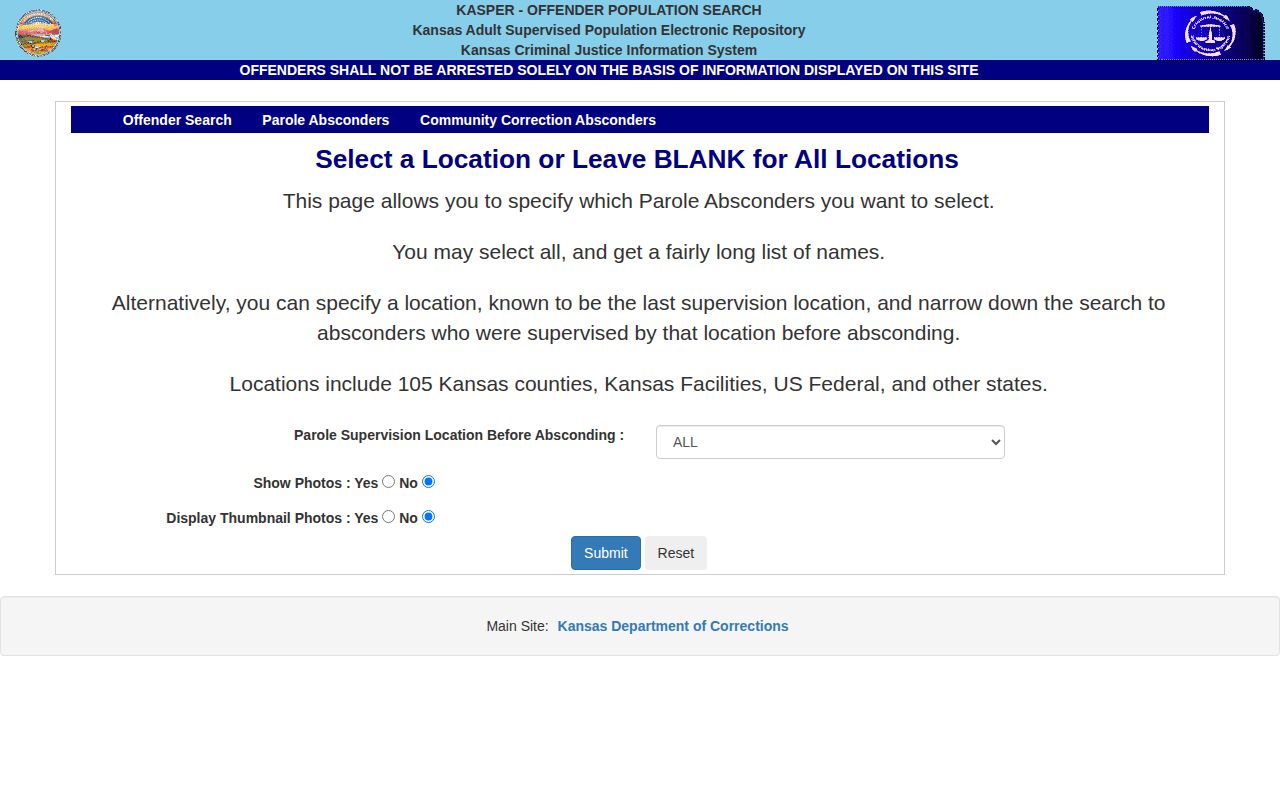
The image reinforces why location before absconding must not be read as a person's present location.
Chase County Supervision Violations
Supervision conditions are rules attached to community release. They may include reporting, lawful conduct, travel approval, and other terms set for the case. Kansas open-record law generally makes ordinary conditions public while protecting specialized counseling or treatment details. Violations that actually led to revocation are among the public KDOC categories, subject to statutory exceptions. A pending claim is not a completed revocation.
Verify a state revocation with KASPER movement and status records or an applicable Board record. Verify probation action in the court docket. A later return to jail or prison does not erase the earlier release. It means the supervision stage changed after the person had entered the community. Kansas VINE covers adults held in participating county jails, not KDOC prison residents, and a custody alert does not explain the legal ruling behind a violation.
Read a violation allegation and a final revocation as separate events; only the controlling agency or court record establishes the outcome.
Chase County Interstate Supervision
KDOC's Interstate Compact for Adult Offender Supervision unit tracks supervised people who enter or leave Kansas. It also manages parole warrant entries and coordinates absconders arrested outside the state. A Kansas-supervised person may live beyond Chase County while the Kansas sentence remains active. Someone living in Chase County may be supervised here for another state.
Residence, conviction county, and supervision county are three different facts. KASPER may identify Chase as the conviction county while listing another parole office. The court case states where the conviction arose. The supervising office identifies who now administers the rules. Match those fields instead of assuming that a Chase County case means local physical presence.
Chase County Supervision Discharge
Physical release and sentence discharge occur at different points. KDOC defines sentence discharge or maximum sentence date as the end of the full state obligation. Until then, a person may be outside prison on parole, conditional release, or mandatory postrelease supervision. KASPER's Discharged status is therefore stronger evidence that KDOC supervision ended than a movement out of a prison.
For probation, use the Chase County court chronology and final order. Look for satisfaction, termination, discharge, or a related disposition tied to that case. An expungement may later restrict ordinary public access, but a missing online record does not by itself prove discharge. The originating court remains the authority on its order.
Keep each proof within its scope. The jail sheet proves departure from Chase County Detention Center. KASPER proves KDOC status. The court proves its sentence and probation orders. A Board calendar proves only a future hearing step. Reading them together avoids calling a transfer a release or calling supervised release the end of a sentence.