
Chase County Projected and Actual Release
“Projected release date” is a useful search phrase, but it is not the precise Kansas label. KDOC says “Anticipated release date,” while its open-record inventory uses “anticipated guidelines release date.” Both describe a computed point within a KDOC sentence. Actual release is the physical departure after staff account for the controlling sentence, earned credits, holds, orders, and destination.
A pretrial Chase County detainee does not have a KDOC anticipated date. Custody may end through bond, dismissal, a court order, transfer, or later sentencing. Even a local sentenced person requires the court order, jail credit, sentence terms, and holds to be read together. Do not place a KASPER date onto a county-jail case that never became a KDOC sentence.
Find a Chase County Inmate Release Date
Classify custody before searching. A local booking, a KDOC commitment, and a federal or immigration hold lead to different records. One name may appear in several systems as custody changes.
- Check whether the person is currently at Chase County Detention Center or was committed to KDOC.
- For KDOC, open KASPER, accept the disclaimer, and search by KDOC number when known.
- Otherwise search by name and narrow the match with birth date, identifiers, conviction county, facility, or supervision type.
- Open the full record and read status, movements, anticipated release, sentence expiration, parole eligibility, and supervision office together.
- For local custody, contact the jail and inspect the Chase County District Court case for bond, sentence, credit, dismissal, or release orders.
- Confirm the current KDOC calculation with Sentence Computation before relying on the displayed date.
“Conviction County: Chase” identifies the source of a case. It does not prove that Chase County is the person's home, supervision county, or release destination. The Chase County release search guide covers the separate county, court, state, and federal paths.
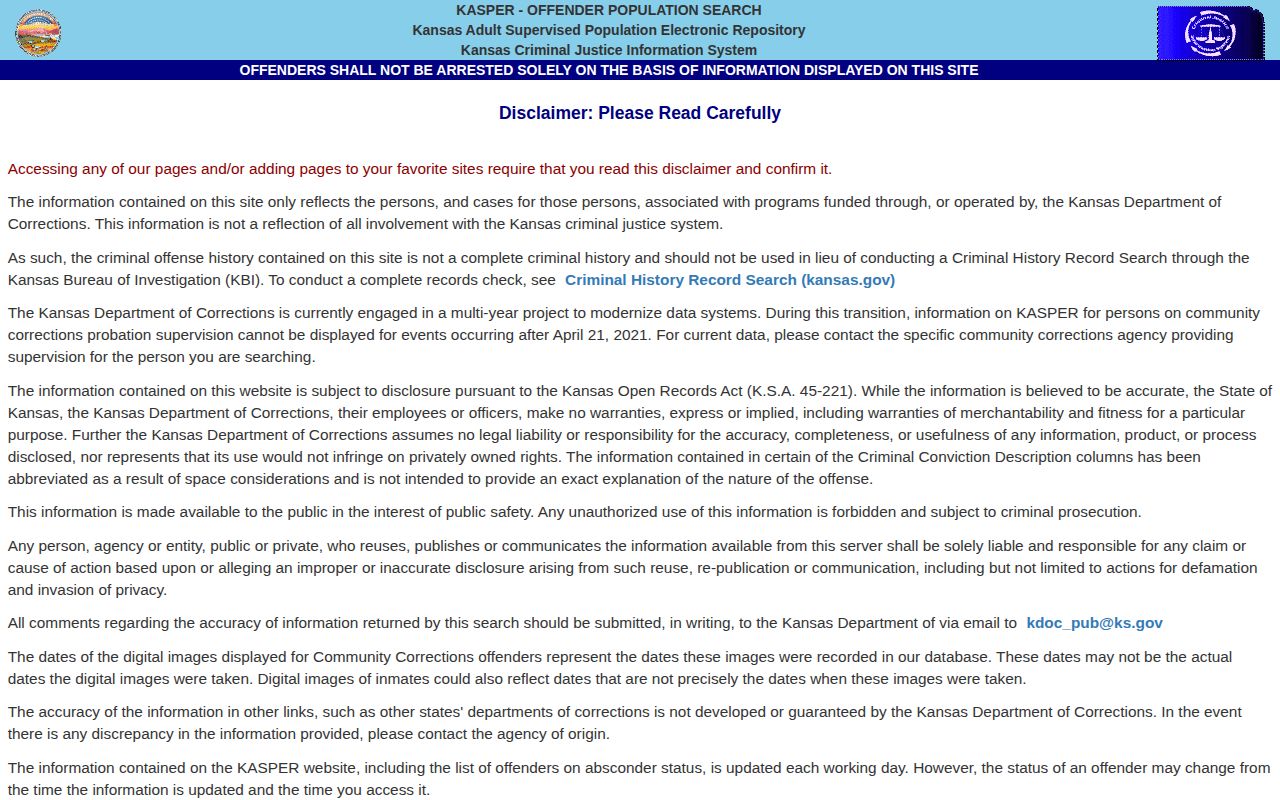
The official KASPER search offers Show Photos, Display Thumbnail Photos, Last Name, First Name, Middle Name, Search Alias, and KDOC Number. Advanced filters include birth date, age range, State ID number, conviction county, parole supervision county, facility, community-corrections location, and supervision type. The successful manifest capture shows that official gateway.
Kansas Good Time and Chase County Cases
K.S.A. 21-6821 caps good time subtracted from many prison sentences for crimes committed on or after July 1, 1993 at 15 percent. When every available day is retained and nothing else changes the term, that rule produces the familiar approximate 85-percent shorthand. It is a maximum-credit model, not a guaranteed release point.
The shorthand is not universal. The same law permits up to 20 percent good time for specified lower-severity nondrug crimes committed on or after January 1, 2008 and for listed drug severity and offense-date combinations. Off-grid, life, special sex-offense, older indeterminate, and other cases follow different rules. Offense date, grid status, severity, and all controlling sentences must be known before the date can be read correctly.
The statute also permits up to 120 days of program credit for qualifying on-grid prisoners who complete listed education, vocational, substance-use, or other approved risk-reduction programs. Eligibility limits apply, and credits can be withheld or forfeited. An older KDOC glossary refers to 60 days, but the current statute supplies the governing 120-day limit.
Why a Chase County Release Date Changes
KASPER is refreshed on working days, so the public display may trail an internal calculation. More important, the facts used in the calculation can change.
| Factor | Effect on the date |
|---|---|
| Good-time conduct credit | Credit earned and retained can shorten the prison portion; forfeiture can move the date later. |
| Program credit | Qualifying completion can reduce the date within statutory limits. |
| Jail credit | Time credited under the sentencing order changes the remaining term. |
| Multiple cases | Concurrent or consecutive terms and time credited elsewhere alter the controlling sentence. |
| Court action | Resentencing, revocation, or a corrected order can produce a new computation. |
| Hold or detainer | Release from one sentence may lead to another custodian rather than the community. |
| Parole decision | In eligible older cases, a grant, denial, continue, or pass affects possible release timing. |
K.S.A. 21-6615 governs jail credit and sentencing-order calculations. A local detention date should therefore be confirmed against the signed order and the jail's record, not estimated from the charge or booking day alone.
Confirm a Chase County Inmate Release Date
For an exact current KDOC calculation, call KDOC Sentence Computation at 785-296-3317 and provide the KDOC number. Read the answer alongside current status, dated movements, sentence expiration, and any supervision office. “Parole” or postrelease status confirms exit from prison into supervision, not the end of the sentence. “Discharged” confirms the KDOC obligation ended.
For a local Chase County detainee, call Chase County Detention Center at 620-273-7054 and ask whether the person is currently held and whether a departure was release or transfer. The court file can explain bond, dismissal, sentencing, probation, revocation, or satisfaction, but a court entry alone does not prove the precise physical exit time.
Kansas VINE can provide a pending custody-change alert for a participating county-jail inmate. The Chase County VINELink release check explains registration and its limits. VINE does not cover KDOC residents and cannot replace the KASPER date or KDOC confirmation.
Older Chase County Parole Eligibility
Pre-July 1, 1993 crimes can fall under the older indeterminate framework in K.S.A. 22-3725. In general, a minimum term of two years or more can earn one day of credit for each day served, reaching parole eligibility at half the minimum if credit remains. A one-year minimum generally reaches eligibility after nine months. Conditional release can relate to half the maximum when credit remains.
Eligibility earns consideration, not release. K.S.A. 22-3717 contains many exceptions, including life-without-parole and specified murder, capital, and off-grid rules. Ordinary post-1993 determinate on-grid prisoners generally proceed to mandatory postrelease after the prison portion rather than discretionary parole. The Prisoner Review Board calendar is a schedule, not a person-by-person outcome database.
Chase County Release-Date Computation Quirks
Kansas's exact field names help prevent false certainty. “Anticipated release date” is a state calculation that can move through good time, program credit, forfeiture, jail credit, and sentence structure. The current statute's 120-day program-credit provision controls over an older glossary's 60-day statement.
The Prisoner Review Board calendar follows a comment, hearing, and possible-release sequence over roughly three months, but the calendar does not establish an outcome. Conviction county also does not identify the return destination. Federal systems differ again: BOP can preserve a released result and past date, while ICE's locator concerns current detention. Always match the date source to the custodian.
Chase County Court and Jail Timing
A Chase County court case can show the event that authorizes or changes custody, but it serves a different role from the jail record. Search by party name or case number, select Chase County, and inspect the criminal chronology and available documents. Bond orders, journal entries, pleas, disposition, sentencing, probation, revocation, dismissal, and satisfaction can each affect why the person remains held or may leave.
For a person awaiting trial, no reliable release-date calculator exists. A bond may be posted, changed, or revoked. Another agency hold may block release after the local bond condition is met. A dismissal may end the local basis for custody while another custodian remains. The signed order explains authority, while the detention center confirms whether and when the physical departure occurred.
For a local sentence, ask for the sentencing order and the recorded jail credit. Compare that material with any other case, detainer, or revocation. Court records can outlast a live roster entry, but a docket entry is not a timestamped jail release sheet. A narrow KORA request for an existing booking/release record is the clearer route to the actual date and transfer or release type.
Read Chase County KASPER Status With Dates
A public KASPER result may show the person's name, KDOC number, birth date, physical description, photograph, conviction, county, case number, housing and dated movements, parole office, custody or supervision level, sentence structure, parole eligibility, conditional release, sentence expiration, and anticipated release date. No single field should be isolated from the rest.
An “Inmate” status points to current KDOC custody, while “Parole” can show release from prison into supervision. “Discharged” has the different meaning that the KDOC sentence obligation ended. A date that has passed beside an inmate status may reflect stale display, a recalculation, or a field with a different legal meaning. Check the latest movement and ask KDOC Sentence Computation for the current controlling calculation.
KASPER also warns that modernization limits some community-corrections information after April 21, 2021. A blank probation event is not proof that supervision ended. Chase County court probation should be checked through the district court or the relevant community-corrections office. State parole and postrelease supervision instead use KDOC Parole Services. Similar location labels do not make those agencies interchangeable.
Identity checks belong at the start of this process. Prefer a KDOC number, then compare the full name, date of birth, physical description, photograph when appropriate, conviction county, and case number. “Conviction County: Chase” is only one matching fact. It does not show the person's home, the county of parole supervision, or the place the person will go after prison.
Write down the date shown and the time the record was checked. If KDOC later supplies a different calculation, keep the current agency answer rather than trying to reconcile the change with a homemade formula. The public record may refresh on a working day after credits, discipline, or a court order have already changed the internal computation.
Finally, distinguish the end of prison confinement from the end of the whole sentence. Mandatory postrelease or parole can begin after physical release. The supervising office, conditions, and final discharge date are separate public facts that require their own confirmation. A projected prison-exit date therefore should not be described as the date all Kansas correctional authority ends unless KDOC confirms discharge.
Search Public Records
Sponsored Results