
Understanding Chase County Releases
“Released” means that one custodian ended its hold on a person. It does not always mean the person walked free. The Chase County Detention Center holds local detainees and also houses people for Immigration and Customs Enforcement and the U.S. Marshals Service. A name that drops from the jail roster might reflect release on bond, a court order, time served, dismissal, sentence completion, or a move to another agency. The destination controls the next search. A local release is documented by the jail and often the court. A Kansas prison transfer moves the record to the Kansas Adult Supervised Population Electronic Repository, known as KASPER. An ICE or federal move must be followed through the federal custodian.
The strongest finding uses affirmative proof. “Not on the roster” is only an observation. A booking and release sheet can state when the person left, the release or transfer type, the releasing authority, and a destination if one was recorded. A signed court order may explain the legal basis. VINE can corroborate a county-jail custody change, while KASPER can show a later state status. These records solve separate parts of the same question.
- Discharge
- The end of the Kansas Department of Corrections obligation, not merely release from a prison building.
- Time served
- Release after the ordered custody term and credited jail time have been satisfied.
- Parole
- Release from an older eligible prison sentence under Prisoner Review Board authority, with supervision continuing.
- Probation
- A court-ordered community sentence supervised instead of, or after, confinement.
Chase County Release Paths
Release labels must be read with the next custodian in mind. Bond is a conditional release while a case is pending. A dismissal ends a charge but may not clear a separate hold. Time served or sentence completion addresses the local term. A commitment to KDOC is a transfer into state custody. ICE and USMS departures can be transfers, removals, returns to another jurisdiction, or federal movements. The Chase County jail record should identify the controlling authority where that fact is recorded.
| Event | Meaning | Next confirmation |
|---|---|---|
| Bond or court release | The local hold may end after bond and other holds clear. | Jail release sheet and signed court order |
| Time served or completion | The local custody term has been met. | Release sheet and case chronology |
| KDOC commitment | Departure from Chase County is a state transfer. | KASPER movements and status |
| ICE or USMS departure | The federal custodian may move or release the person. | ICE locator, federal agency, or BOP record as applicable |
A transfer and a community release can occur on the same day for different people, yet both names may vanish from the public roster. That is why the release type and authority matter more than roster absence.
Chase County Release Record Fields
A narrow request should ask for an existing booking and release sheet, not ask staff to research or answer a broad question. Use the full name and date of birth or booking number, plus an approximate booking window. The record may connect the initial admission with the final departure and any receiving custodian. Availability depends on what the jail recorded and on lawful exemptions.
| Requested field | What it can establish |
|---|---|
| Admission date and time | The start of the linked Chase County booking |
| Release date and time | The recorded departure from the facility |
| Release or transfer type | Bond, order, completion, dismissal, or movement |
| Releasing authority | The agency or court action controlling departure |
| Destination or custodian | Another agency or facility, when recorded |
| Charges and case number | The link to the court chronology |
| Booking photograph | The image tied to that admission, if open and retained |
The date has a precise scope. It proves departure from the Chase County Detention Center, not the absence of all other custody. A later court record can explain the order, but it may not show the physical exit time. KASPER, BOP, or ICE evidence is needed when another system took control.
Request Chase County Release Records
The Chase County Clerk KORA page provides the county request form and explains the response process. Ask for electronic copies and request a cost estimate before chargeable work. No flat Chase County release-sheet fee or public retention interval was found. Kansas law requires a response within three business days that provides the record, states when and how it will be supplied and at what cost, or explains the reason it cannot be produced. That deadline is not a guarantee of final delivery.
- Identify the person with full name, date of birth or booking number, and a useful date range.
- Request the booking and release sheet, release date and time, release or transfer type, authority, destination, charges, case number, and booking photo.
- Ask for electronic records and an estimate before staff performs work that may carry a charge.
- Compare the response with the Chase County court case and any named receiving custodian.
301 S. Walnut
P.O. Box 639
Cottonwood Falls, KS 66845
620-273-7054
ccdc@chasecountyks.com
Administrative record service should not be assumed to run around the clock merely because the sheriff's general office states it is open at all times. Call before visiting. If a request is denied in whole or part, ask for the legal basis and for any segregable open portion.
Kansas Rules for Chase Releases
The Kansas Open Records Act creates the request framework, while K.S.A. 45-221 lists exemptions that can affect criminal-investigation material, protected personal data, and some correctional records. A custodian may withhold exempt details while releasing an open part. Court access also has limits. Sealed, expunged, many juvenile, child-in-need-of-care, adoption, and grand-jury materials are not available through ordinary public search.
Under K.S.A. 21-6614, an eligible Chase conviction expungement is filed in the convicting court. Waiting periods are measured from sentence satisfaction or discharge from probation, parole, or postrelease supervision. An expunged case becomes unavailable to ordinary public search, subject to statutory exceptions. Expungement should not be described as a routine deletion from every agency system.
Find Chase County Released Inmates
The public sheriff roster is a current-custody tool. Its “Books 24hr” control means bookings during the prior day, not releases. Public past-inmate access was disabled when the research was checked, and no official Chase County recent-release archive was found. Start with the roster only to see whether the person remains listed. Then seek a positive release or transfer record.
- Check the official Chase County jail roster for current custody, but do not treat absence as proof of release.
- Call the detention center and ask whether the person was released or transferred, using stable identifiers.
- Request the booking and release sheet for the relevant date window.
- Search the Chase County criminal case for the signed bond, dismissal, sentencing, or release order.
- Follow KASPER, ICE, USMS, or BOP when the record names another custodian.
The Released Last 24 Hours route explains the same-day fallback. For a state sentence, the Inmate Release Date page explains the Kansas date fields without turning them into a promise.
Kansas Search for Chase Releases
KASPER, the Kansas Department of Corrections offender search, applies to people who entered KDOC custody or supervision. It does not repair the missing Chase County local release archive for a person who never entered the state system. Search by name or KDOC number, use aliases where appropriate, and compare the record with the conviction county, case number, physical description, and dated movements.
| Search field | Use |
|---|---|
| Last, first, middle name | Basic identity search |
| Alias | Include recorded alternative names |
| KDOC or KBI number | Strong agency identifier |
| Birth date or age range | Narrow common-name results |
| Conviction county | Find a Chase County court commitment |
| Supervision type | Filter Inmate, Parole, Discharged, and other statuses |
KDOC may show a photograph, offenses, case number, movements, parole office, sentence structure, parole eligibility, conditional release, sentence expiration, and the “anticipated guidelines release date.” “Parole” indicates prison release with supervision continuing. “Discharged” means the KDOC obligation ended.
The official KASPER disclaimer and search gateway is shown below. The image documents the state portal, while the live record remains the source to recheck.
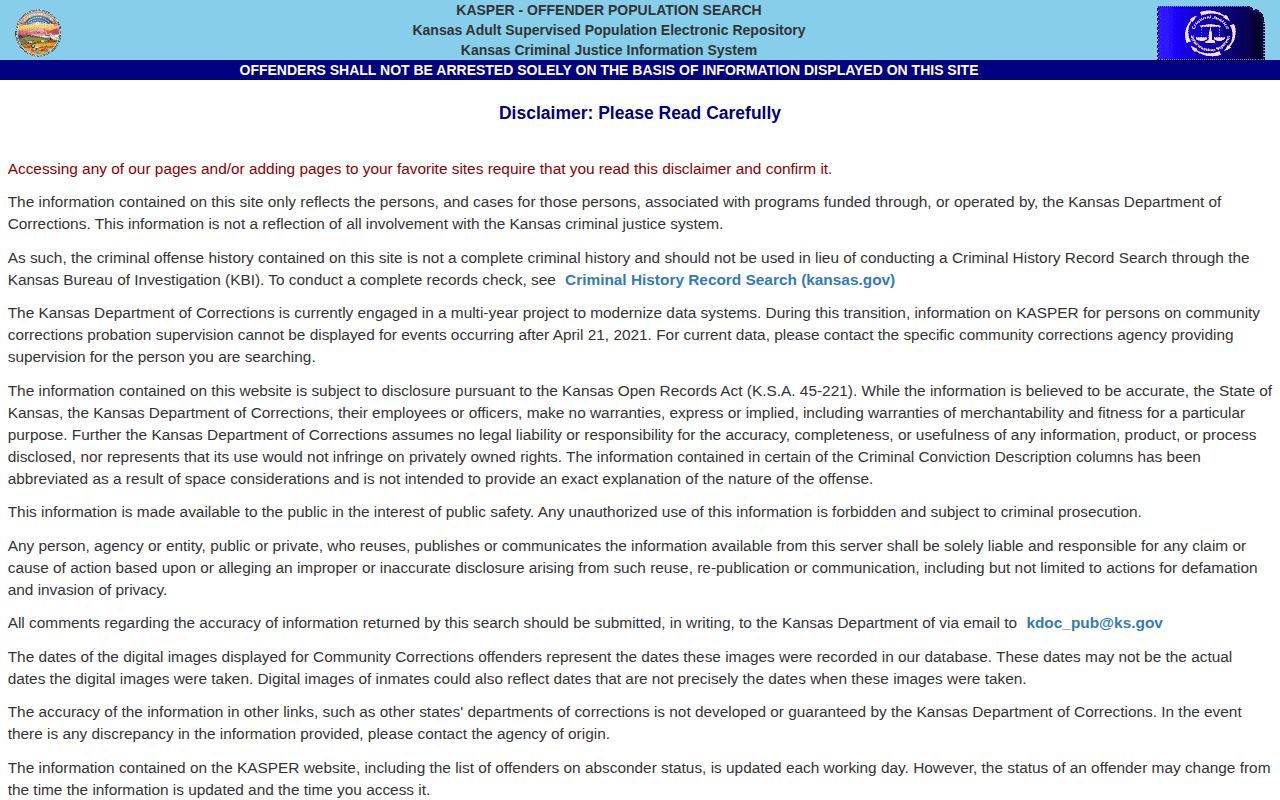
KASPER uses a CAPTCHA and refreshes on working days, so a new movement may not appear at once.
Chase County Recent Release Limits
No official 24-hour or 72-hour Chase County release feed, public past-inmate archive, update schedule, or retention period was found. The roster vendor can display a release-date slot, but Chase County did not expose public past records. A current name confirms a current listing; disappearance does not explain what happened. A narrow KORA request, a direct jail call, VINE corroboration, and the court record form the local fallback chain.
No sheriff-branded public inmate lookup or recent-release mobile app was identified. VINEMobile serves alerts for participating county-jail custody, while calling, visit, commissary, and payment apps are not release lists. Do not substitute another county's feed or an arrest site for an official Chase County release record.
Chase Release Supervision Records
Kansas parole and postrelease supervision are handled by KDOC Parole Services. Chase County falls within the Emporia Parole Office area. County-court probation is different: Court Services of the Fifth Judicial District supervises it from Emporia. A shared city does not make the agencies interchangeable. KASPER can show a parole office or supervision type for KDOC cases, while a Chase court docket and clerk record establish local probation orders.
An absconder is a supervised person whose whereabouts are unknown after failure to report or comply. KASPER provides separate parole and community-corrections absconder searches, but an absconder listing is not the same as a new jail booking. The full Parole / Probation page separates board decisions, state supervision, community corrections, and court services.
Chase Release Alerts and Federal Records
VINELink covers adults in participating Kansas county jails, including the kind of county custody handled in Chase County. It expressly excludes KDOC prison residents and does not cover BOP, ICE, or USMS custody. Search by first and last name or offender ID, compare the facility and identifiers, then register phone, text, email, or app alerts for that person. A custody-change alert may not state the legal reason or prove that no agency assumed custody.
For federal prison records, the BOP Inmate Locator preserves many released results and a release date. A past date with location “RELEASED” means no current BOP facility, not necessarily an end to supervision or other custody. ICE's online locator addresses current detention and is not a release archive. A USMS departure may be a transfer between agencies. Call the named authority when a Chase record identifies a federal hold.
Compare Chase County Release Sources
Each system proves only the status held by its own agency. Match the source to the custody context before drawing a conclusion.
| Source | Best use | Key limit |
|---|---|---|
| Chase jail roster | Current county listing | No public release archive |
| Booking/release sheet | Departure time, type, authority, destination | Proves departure from this facility only |
| Chase court record | Bond, dismissal, sentence, probation, signed order | Order time may differ from physical exit |
| KASPER | KDOC custody, parole, discharge, movements | Not a local-only jail archive |
| VINELink | County-jail custody alert | Reason and later custodian may be absent |
| BOP or ICE | Federal status in the appropriate system | ICE locator focuses on current custody |
Chase County Release Facility
Chase County Detention Center is the only verified detention facility physically in the county. It is county-owned and county-operated, yet it also holds ICE and potentially USMS detainees by agreement. That mixed role makes a roster disappearance unusually ambiguous. A local detainee may return to the community, enter KDOC custody, or move under another hold. A federal detainee may transfer, return to another jurisdiction, or leave under federal authority.
The ICE detention-facility directory identifies the same site as Chase County Jail. Confirm which agency controlled the person before choosing the locator or requesting records.
When Chase County Bond Ends
The detention center's published bond procedure distinguishes own-recognizance, cash, cash-or-surety, and cash-only bonds. When another agency controls a hold, that agency must accept its bond and notify CCDC. Staff then check for other holds before an eligible person leaves through the lobby doors. Bond payment and physical release can therefore have different times.
No standard pickup hour or weekend and holiday release timetable was published. Call 620-273-7054 before arranging transportation. A lobby exit confirms departure from CCDC, while the release sheet and court record explain the authority and conditions.
Property After Chase County Release
CCDC states that approved original personal mail is placed with the person's property for access after release. A transfer is different. Receiving-facility rules, return fees, or disposal rules may affect property, so leaving the building does not always create an ordinary pickup event. Written data-accuracy complaints may be sent to CCDC at its Walnut Street address.
Ask the jail about the property tied to the specific release or transfer. Do not infer that all belongings traveled with the person or became ready for a third party to collect.
Chase Release Orders and Dockets
The Fifth Judicial District Chase docket is updated daily, covers a short future window, and can change. It helps locate a hearing. It is not final disposition evidence and does not prove the time a person left the jail. Use the Kansas district-court records route or contact the clerk for the signed order and case chronology.
Compare order time with the later jail entry. Processing and another hold can intervene. Reporting both timestamps is more accurate than forcing them into one “release time.”
Chase County Release Date Terms
Kansas uses “anticipated release date” and “anticipated guidelines release date” for KDOC records. Credits, forfeitures, jail credit, concurrent or consecutive terms, resentencing, and revocation can change that date. It is not the same as discharge. KASPER “Parole” or postrelease status can show prison exit with supervision continuing; “Discharged” marks the end of KDOC obligation.
The Prisoner Review Board calendar is prospective. Its sequence of public comment, hearing, and possible later release does not prove that parole was granted. No official person-by-person outcomes search was found. Verify the later status in KASPER or request the decision.
Search Public Records
Sponsored Results